






Schwarzwald Marie Goes to Memphis
Oksana Neitzke has been a close friend of mine for over 30 years. We met in Rivne, Ukraine, in 1992, shortly after the Berlin Wall fell in 1989. Doors across Eastern Europe that had been shut for generations opened, including the door to Ukraine. I joined my church friends as we walked through that door many times on a dozen mission trips to share the Gospel. Oksana, my translator, made sure every word of hope was heard.
A quick study with a servant’s heart, Oksana has steadily broadened her influence for the Kingdom throughout former communist regions, multiplying her impact far beyond what any of us could have imagined over the last 30 years.
More recently, she perfected her knowledge of a proper afternoon tea during my visit to Germany three years ago and has cultivated ideas from our website. Always a quick study, Oksana grasps not only its elegance but its spirit, the gracious ritual of tea served well.
By trade, she’s a hotelier. She and her husband own and run Hotel Kirchbuhl, in the Black Forrest of Eastern Germany, where guests check in as strangers and somehow check out feeling like family. By calling, she’s a champion for refugee children, displaced by the war in Ukraine. And by gift, she’s a journalist who believes every person carries a story worth telling, and who takes the time to tell it well.
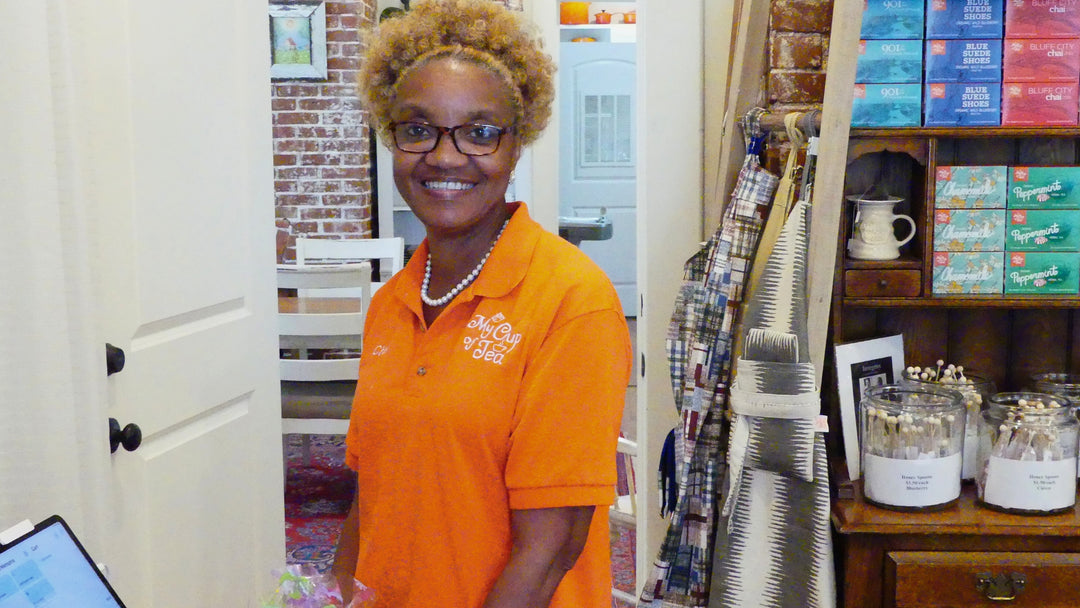
During a delightful visit to Memphis this Summer, she cleverly tucked “Marie” into nooks and crannies at The House to share the story. This weekend she posted the delightful tribute that follows:
A BLACK FOREST LADY WALKS INTO MY CUP OF TEA…
Under the Stars and Stripes, thousands of miles from her beloved Black Forest, Schwarzwald Marie found herself on an American adventure.
Some people travel to Memphis for the Blues. Others come for Elvis, barbecue, or a pilgrimage to Graceland. And Marie? She had an entirely different destination in mind.
A true Black Forest girl, dressed in her finest traditional costume, with a hat carrying enough cherries to bake an entire Black Forest cake. And what had brought her to the American South? She was looking for tea, naturally. What else?
Marie comes from a part of Germany where hospitality is an old and serious business. At Hotel Kirchbühl in Schönau im Schwarzwald, we have been opening our doors to travelers since 1850. We know that the best conversations often begin with a cup of something warm and something delicious on a plate. So, when Marie arrived at My Cup of Tea in historic Orange Mound, she discovered something that felt wonderfully familiar, despite the thousands of miles between Memphis and the Black Forest. A place where a cup of tea is about much more than what is in the teapot; It is about people, about stories, about making room at the table, about the beautiful, slightly old-fashioned idea that a stranger needs not remain a stranger for very long.
And suddenly, Marie's American adventure made perfect sense. Perhaps she hadn't travelled across the ocean to discover something new after all. Perhaps she had travelled all that way to rediscover something she already knew; that wherever kind people gather around a table, a little piece of home comes into being.
Memphis, you have a new friend in the Schwarzwald. And she has a very large hat.
With love, tea, and a generous slice of cake,
Your Schwarzwald Marie.

